
Snowball sampling is a non-probability sampling technique used primarily in qualitative and social science research to access populations that are hard to reach or identify through conventional methods. The method begins with a small, initial set of participants known as “seeds,” who meet the study criteria. These seeds then refer or recruit other individuals from their network who also meet the criteria. This chain-referral process continues iteratively, with new participants referring further contacts, causing the sample size to grow progressively like a snowball rolling downhill. Snowball sampling is valuable for studying hidden populations, such as people with rare diseases, marginalized groups, or individuals with sensitive characteristics.
More precisely, Snowball sampling is an important non-probability sampling where a chain referrel exist. A researcher first select a respondent to collect data then this respondent refers one or more respondent and in this chain everyone refer one or more respondent until the requirements of the researcher fulfilled.
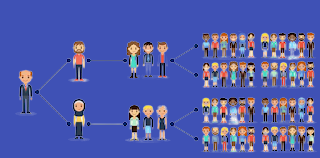
What is Snowball Sampling?
Snowball sampling relies on participant networks for recruitment rather than random selection, meaning each member does not have an equal probability of inclusion. As a non-probability method, it limits the ability to generalize findings to the larger population but excels in exploratory studies and contexts where no sampling frame exists. The method also helps researchers gain trust and access in closed or hard-to-identify communities by leveraging existing social ties. It is sometimes called chain sampling or network sampling, reflecting its referral-based growth.
More precisely, Snowball sampling is a chain referral sampling. It’s a non-probability sampling where existing study subjects recruit future subjects from among their acquaintances. Thus the sample group is said to grow like a rolling snowball. This sampling technique is often used in hidden populations, such as drug users or sex workers, which are difficult for researchers to access.
Steps in Snowball Sampling
- Identify the population to study
- Choose some samples to get the snowball rolling
- Ask the initial subjects to nominate others who they know fit the description of potential subjects
- Repeat the above process until you have sufficient data
More precisely,
The steps to implement snowball sampling effectively are:
- Select Initial Seeds: Identify a few participants who meet study criteria and are well-connected in the target population.
- Recruit Initial Participants: Contact and recruit these seeds, explain the study, and gain their consent.
- Referral Process: Ask seeds to refer others who meet inclusion criteria. Provide incentives or motivations if appropriate.
- Expand the Sample: Recruit referred participants, then ask them for further referrals, continuing the chain until the desired sample size or saturation is reached.
- Data Collection: Conduct interviews, surveys, or observations during each recruitment wave.
- Monitor Bias: Researchers should monitor sample composition and diversity to reduce network or selection biases.
This iterative recruitment process allows researchers to build trust with participants and access populations that might be otherwise inaccessible.
Types of Snowball Sampling
- Linear Snowball Sampling: Subject refers only one other subject. The researcher starts with one participant who refers one new participant, and this chain continues sequentially. It suits scenarios where each link independently connects to only one other potential participant.
- Exponential Non-Discriminative Snowball Sampling: Subject gives multiple referrals and each referral gives some more until required sample size is reached. The first participant refers multiple new participants, each of whom further refers others, resulting in geometric growth of the sample size. This approach is effective in expanding the sample quickly but requires careful management of network bias.
- Exponential discriminative Snowball Sampling: Subject refers multiple people but only one is chosen as sample. Researchers control or limit the number of referrals or participants recruited at each stage to manage bias and sample composition better.
Applications
Snowball sampling is usually used in cases where there is no pre-calculated list of target population details (homeless people), there is immense pain involved in contacting members of the target population (victims of rare diseases), members of the target population are not inclined towards contributing due to a social stigma attached to them (hate-crime, rape or sexual abuse victims, sexuality, etc.) or the confidentiality of the organization respondents work for (CIA, FBI or terrorist organization).
- Medical Practices: There are many less-researched diseases. There may be a restricted number of individuals suffering from diseases such as progeria, porphyria, Alice in Wonderland syndrome etc. Using snowball sampling, researchers can get in touch with these hard to contact sufferers and convince them to participate in the survey research
- Social research: Social research is a field which requires as many participants as possible as it is a process where scientists learn about their target sample. When social research is to be conducted in domains where participants might not necessarily willing to contribute such as homeless or the less-fortunate people.
Advantages
- It’s quicker to find samples: Referrals make it easy and quick to find subjects as they come from reliable sources. An additional task is saved for a researcher, this time can be used in conducting the study.
- Cost effective: This method is cost effective as the referrals are obtained from a primary data source. It’s is convenient and not so expensive as compared to other methods.
- Sample hesitant subjects: Some people do not want to come forward and participate in research studies, because they don’t want their identity to be exposed. Snowball sampling helps for this situation as they ask for a reference from people known to each other. There are some sections of the target population which are hard to contact. For example, if a researcher intends to understand the difficulties faced by HIV patients, other sampling methods will not be able to provide these sensitive samples.
Disadvantages/ Downsides of snowball sampling
- Sampling bias and margin of error: Since people refer those whom they know and have similar traits this sampling method can have a potential sampling bias and margin of error. This means a researcher might only be able to reach out to a small group of people and may not be able to complete the study with conclusive results.
- Lack of cooperation: There are fair chances even after referrals, people might not be cooperative and refuse to participate in the research studies
Practical Examples
- Public Health Studies: Recruiting individuals living with HIV/AIDS or rare genetic disorders through community networks.
- Sociological Research: Investigating marginalized communities such as homeless populations or undocumented immigrants.
- Criminal Justice Research: Accessing samples of drug users or formerly incarcerated people via peer referrals.
- Marketing: Identifying niche consumer groups or influencers within specialty markets through network referrals.
Each example illustrates how snowball sampling leverages social connections to reach otherwise inaccessible participants.
Conclusion
Snowball sampling serves as a powerful, practical approach for researchers exploring difficult-to-reach populations by harnessing the trust and social connections within communities. It overcomes challenges related to unavailable sampling frames and accessibility but requires caution around bias, representation, and ethical concerns. When used thoughtfully and transparently, snowball sampling facilitates rich qualitative insights that would be unattainable through conventional sampling methods, supporting research in public health, social sciences, and beyond. Data Science Blog
Q&A
Q: What differentiates snowball sampling from probability sampling?
A: Snowball sampling is non-probability based, recruiting via participant referrals without equal selection chances, unlike probability sampling which uses random selection to ensure representativeness.
Q: How does the sample size grow in snowball sampling?
A: Sample size increases iteratively through referral waves, either linearly or exponentially depending on the recruitment type.
Q: Can snowball sampling results be generalized to the population?
A: No, snowball samples are typically not representative, limiting inferential generalizations.
Q: When is snowball sampling most useful?
A: For studying hidden, rare, or stigmatized populations where sampling frames are unavailable.
Q: How do researchers minimize bias in snowball sampling?
A: By diversifying seeds, limiting referrals, and monitoring sample composition throughout recruitment.