
Support vector machines are key in machine learning, focusing on supervised learning. They help in analyzing data and making predictions. They are essential for professionals to make accurate predictions and classifications.
Support vector machines are used to solve complex problems in machine learning. They are a vital tool for professionals. Their use has led to big improvements in supervised learning, making predictions and classifications more accurate.
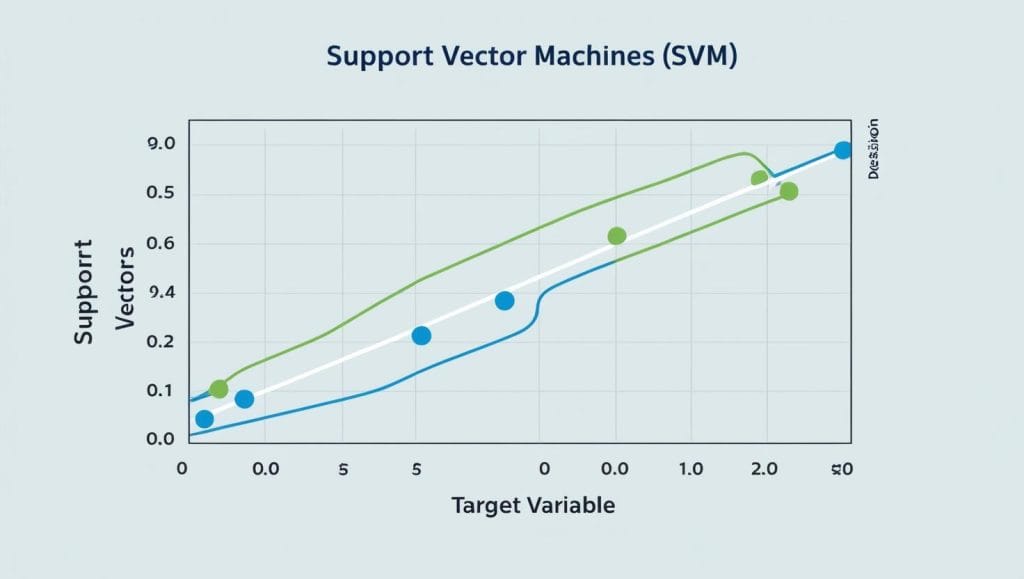
Exploring support vector machines shows they are critical in machine learning. They provide a strong framework for supervised learning. Their uses are wide, from data analysis to predictive modeling. They are a must-have tool in machine learning.
Understanding Support Vector Machines: A Comprehensive Overview
Support Vector Machines (SVM) are a key tool in data analysis. They help find patterns and make predictions. This makes them essential for businesses and organizations to make smart decisions based on data.
The idea behind SVMs is to find the best hyperplane to separate data into classes. They use kernel functions to do this. These functions turn the data into a higher space, making it easier to classify. The goal is to make the classifier as accurate and robust as possible.
What Are Support Vector Machines?
SVMs are a type of supervised learning algorithm. They need labeled data to learn. The algorithm finds the support vectors, which are the closest data points to the hyperplane. These points are key in defining the class boundaries.
The History of SVM Development
The story of SVMs started in the 1990s with Vladimir Vapnik and Alexey Chervonenkis. They introduced the idea of support vector machines. Over time, SVMs have seen big improvements, thanks to new kernel functions and optimization methods.
Key Components of SVM Architecture
The main parts of SVM architecture are the kernel function, support vectors, and margin. The kernel function maps data into a higher space. The support vectors set the class boundaries. The margin is the gap between classes, which is maximized for better accuracy and robustness.
The Mathematical Foundation Behind SVMs
Support Vector Machines (SVMs) rely on predictive modeling to make accurate predictions. This is key for algorithm optimization. At their core, SVMs use mathematical equations to classify data and predict outcomes.
Kernels play a big role in SVMs. They help turn non-linear data into something linear. This lets SVMs solve non-linear problems using linear methods. Kernel functions do this by mapping data into a higher space.

The math behind SVMs also includes algorithm optimization like margin optimization and selecting support vectors. These steps improve SVM performance. By combining predictive modeling and algorithm optimization, SVMs achieve high accuracy and efficiency. This makes them a top choice for many applications.
Some important concepts in SVM math are:
- Linear and non-linear equations
- Kernel methods and kernel functions
- Margin optimization and support vector selection
- Predictive modeling and algorithm optimization techniques
Linear Support Vector Machines Explained
Linear Support Vector Machines (SVMs) are key in machine learning. They find the best hyperplane to split data into classes. This happens because of linear separability, which means a single line can separate the data.
The main goal is to widen the margin optimization as much as possible. This is the space between the hyperplane and the closest data points. The support vector machines algorithm uses special points, called support vectors, to make this margin as wide as it can be.
Understanding Linear Separability
Linear separability is vital for linear SVMs. It lets the model split data into different groups. This is done with a linear equation that finds the best hyperplane.
Margin Optimization
Margin optimization is a big deal for linear SVMs. It makes sure the model can handle new data well. This is done by widening the space between the hyperplane and the closest data points.
The Role of Support Vectors
Support vectors are very important in linear SVMs. They help make the margin as wide as possible. The support vector machines algorithm uses these special points to do this.
Knowing about linear separability and margin optimization helps developers make better support vector machines. These models can handle new data well.
Kernel Functions and Non-linear Classification
Kernel methods are key in making SVM algorithms better, allowing for non-linear classification. They let SVMs work in higher-dimensional spaces. This is great for datasets that can’t be separated by a straight line.
There are many kernel functions, like polynomial, radial basis function (RBF), and sigmoid. Each has its own good points and bad points. The right kernel depends on the problem and data. For example, the RBF kernel is often used for complex tasks because it works well with high-dimensional data and avoids overfitting.
Some important things about kernel functions include:
- They can handle non-linear relationships between features
- They offer flexibility in choosing the kernel type and parameters
- They are good at dealing with noisy or outlier data
Kernel methods are used in many areas, like image and text classification, and bioinformatics. They help SVMs do well in non-linear tasks.
In short, kernel functions are a big help for non-linear classification. They’ve been key in making SVMs very good at many tasks. Knowing about different kernel functions and their features helps experts pick the best one for their problems.
| Kernel Type | Description |
|---|---|
| Polynomial | Used for datasets with polynomial relationships between features |
| RBF | Commonly used for non-linear classification tasks, handles high-dimensional data |
| Sigmoid | Similar to the RBF kernel, but with a sigmoid-shaped decision boundary |
Training Your First Support Vector Machine Model
To start training a Support Vector Machine (SVM) model, understanding data analysis is key. It helps find patterns and relationships in your data. This step includes collecting, cleaning, and preparing your data for the SVM algorithm.
Preparing your data involves several steps. These include:
- Data collection: Gathering relevant data for your specific problem or task.
- Data cleaning: Removing any missing or duplicate values from the dataset.
- Data preprocessing: Normalizing or scaling the data to ensure it’s in a suitable range for the SVM algorithm.
After preparing your data, you can set up your model parameters. This includes choosing the kernel type and regularization parameter. The right kernel depends on your data and problem. For example, a linear kernel works well with linear data, while non-linear kernels like polynomial or RBF are better for complex data.
SVMs are great for both classification and regression tasks. The success of your model depends on picking the right kernel and parameters. This way, you can build a reliable SVM model that offers valuable insights and predictions.
| Kernel Type | Description |
|---|---|
| Linear | Suitable for linearly separable data |
| Polynomial | Suitable for non-linearly separable data |
| RBF | Suitable for non-linearly separable data |
By following these steps and carefully evaluating your data and model parameters, you can train a successful SVM model. This model will provide accurate and reliable predictions, unlocking the power of predictive modeling with svm and data analysis.
Hyperparameter Tuning for Optimal Performance
Hyperparameter tuning is key to getting the best out of Support Vector Machines (SVMs). It involves adjusting parameters like the regularization, kernel, and margin. These tweaks can greatly boost the accuracy and speed of SVM models. This is vital for algorithm optimization and predictive modeling.
To fine-tune these parameters, developers use cross-validation. This method checks how well the model does on unseen data. It helps avoid overfitting and ensures the model works well on new data. Important parameters to adjust include:
- Regularization parameter: controls the balance between margin and error
- Kernel parameter: picks the type of kernel, like linear or RBF
- Margin parameter: sets the margin width between classes
By fine-tuning these parameters, developers can make SVM models that are both accurate and efficient. These models are great for many tasks, from predictive modeling to algorithm optimization. Using cross-validation and other methods ensures the model is reliable and adaptable, which is essential for top performance.
In short, tuning hyperparameters is a critical step in making SVM models. By employing cross-validation and adjusting key parameters, developers can craft models that excel in various fields. This includes algorithm optimization and predictive modeling.
| Hyperparameter | Description |
|---|---|
| Regularization parameter | Controls the trade-off between margin and misclassification error |
| Kernel parameter | Determines the type of kernel used, such as linear or RBF |
| Margin parameter | Controls the width of the margin between classes |
Advanced SVM Techniques and Applications
Support vector machines (SVMs) are used in many areas, like multi-class classification and svm regression. These advanced methods help SVMs solve complex problems and give precise results. They are great for predictive modeling, helping to sort data into several categories.
One big challenge in multi-class classification is dealing with imbalanced datasets. SVMs can tackle this by adjusting the data. They can either add more data to the smaller class or remove some from the larger class. SVMs are also good for svm regression, which predicts continuous values.
Key Applications of SVM
- Multi-class classification: used in applications such as image classification and text classification
- SVM regression: used in applications such as predictive modeling and forecasting
- Handling imbalanced datasets: used in applications such as credit risk assessment and medical diagnosis
Overall, SVMs are a key tool in machine learning. Their advanced methods and uses make them a favorite in many fields. By using SVMs, businesses and organizations can get important insights and make better decisions.

Common Challenges and Solutions in SVM Implementation
Support Vector Machines (SVMs) are key in data analysis and predictive modeling. Yet, they face challenges like overfitting and underfitting. Overfitting happens when a model is too detailed and doesn’t work well with new data. Underfitting occurs when a model is too simple and misses important data patterns.
To tackle these issues, regularization is a helpful tool. It adds a penalty to the loss function to keep the model simple. This makes the model better at predicting new data and prevents overfitting. SVMs use soft margin classifiers to allow for some mistakes in training data.
- Collecting and preprocessing high-quality data to ensure accurate predictive modeling
- Selecting the appropriate kernel function and tuning hyperparameters for optimal performance
- Using techniques such as cross-validation to evaluate model performance and prevent overfitting
By using these strategies and regularization, analysts can solve common SVM problems. This leads to better predictive modeling results with svm and data analysis.
Integrating SVMs with Popular Machine Learning Libraries
Support vector machines (SVMs) can be linked with top machine learning libraries. This boosts their power and performance. Scikit-learn is a leading library that offers many tools for SVMs. It makes it easy for developers to use SVM algorithms and kernel methods.
LibSVM is another key library for SVMs. It has many kernel functions and options for tweaking parameters. Developers can also write custom SVM solutions in Python or R. This lets them tailor solutions for unique needs.
Integrating SVMs with machine learning libraries brings several benefits. These include:
- Improved performance and accuracy
- Enhanced functionality and flexibility
- Easier implementation and deployment
By using libraries like scikit-learn and LibSVM, developers can build strong SVM models. These models help businesses gain valuable insights and drive success.
| Library | Features | Benefits |
|---|---|---|
| scikit-learn | SVM algorithms, kernel methods | Easy implementation, high performance |
| LibSVM | Comprehensive kernel functions, parameter tuning | Versatile, flexible, and accurate |
Real-world Applications of Support Vector Machines
Support vector machines are used in many fields like finance, healthcare, and marketing. They are great at predictive modeling and data analysis. They help with tasks like predicting stock prices, diagnosing diseases, and understanding customer behavior.
Here are some examples of how support vector machines are used:
- Predicting credit risk in finance
- Diagnosing diseases in healthcare
- Identifying customer behavior in marketing
These examples show how important support vector machines are in predictive modeling and data analysis.
Support vector machines are also used in image classification and text classification. They can handle complex data and non-linear relationships. This makes them a favorite for many tasks.
| Industry | Application | Benefits |
|---|---|---|
| Finance | Predicting credit risk | Improved risk assessment |
| Healthcare | Diagnosing diseases | Accurate diagnosis and treatment |
| Marketing | Identifying customer behavior | Targeted marketing and improved customer satisfaction |
Overall, support vector machines are a powerful tool for predictive modeling and data analysis. They have many real-world applications.
Performance Optimization and Scaling SVMs
Working with support vector machines (SVMs) means focusing on performance and scaling. To boost SVM performance, using memory management is key. This includes caching and parallel processing. These methods help handle big datasets, making SVMs work for tough tasks.
Some important ways to improve SVM performance are:
- Using parallel processing to split tasks
- Applying caching to speed up memory access
- Adjusting model parameters for better efficiency
These strategies can greatly enhance SVM performance. This lets SVMs deal with big datasets and complex tasks. Scaling SVMs is vital for real-world use, where fast and accurate data processing is needed. With these techniques, developers can make SVM models that add real value to businesses.
The success of SVMs depends on optimizing performance and scaling. Knowing how to apply these strategies unlocks SVM’s full power. This leads to innovation in various fields.
| Technique | Description |
|---|---|
| Parallel Processing | Distribute tasks across multiple processors |
| Caching | Store data in memory for quicker access |
| Model Optimization | Adjust parameters for better efficiency |
Comparing SVMs with Other Machine Learning Algorithms
Machine learning algorithms like support vector machines (SVMs) are well-liked. But, they’re not the only game in town. We’ll look at how SVMs stack up against other algorithms, like decision trees, random forests, and neural networks.
SVMs shine when dealing with lots of data and complex patterns. Compared to decision trees and random forests, SVMs are better at tackling tough data. Neural networks can also handle complex data, but they might be slower and more resource-hungry than SVMs.
Here are some key points to consider when comparing SVMs to other machine learning algorithms:
- SVMs are effective in handling high-dimensional data and non-linear relationships.
- Decision trees and random forests are more interpretable than SVMs, but may not perform as well on complex data sets.
- Neural networks are capable of handling complex data, but can be more computationally intensive than SVMs.
Choosing between support vector machines and other machine learning algorithms depends on your specific needs. Knowing the strengths and weaknesses of each helps developers make the best choice.
The following table summarizes the key differences between SVMs and other machine learning algorithms:
| Algorithm | Strengths | Weaknesses |
|---|---|---|
| SVMs | Handle high-dimensional data, non-linear relationships | Can be computationally intensive |
| Decision Trees | Interpretable, easy to implement | May not perform well on complex data sets |
| Random Forests | Handle high-dimensional data, robust to overfitting | Can be computationally intensive |
| Neural Networks | Capable of handling complex data, flexible | Can be computationally intensive, require large amounts of data |
Best Practices for SVM Model Deployment
Deploying support vector machines (SVMs) requires careful planning. It’s important to validate models, consider the production environment, and monitor them. This ensures the model works well in real-world settings. By doing this, developers can use machine learning to make better business decisions.
Model validation is key. It checks how well SVMs perform. Using cross-validation and walk-forward optimization helps. These methods give a clearer picture of the model’s strengths and weaknesses. This way, developers can make the model more accurate and reliable.
Key Considerations for Model Deployment
- Model validation strategies: cross-validation, walk-forward optimization
- Production environment considerations: scalability, security, reliability
- Monitoring and maintenance: performance metrics, model updates, troubleshooting
Following best practices for deploying SVMs can lead to great success. SVMs are good at handling complex data and relationships. This helps in making better decisions and growing the business. As machine learning grows, so does the need for good deployment practices.
By focusing on best practices, organizations can make sure their SVMs perform well. They will be ready to help the business succeed in a changing world.
| Model Validation Strategy | Description |
|---|---|
| Cross-Validation | Evaluates model performance by training and testing on multiple subsets of data |
| Walk-Forward Optimization | Evaluates model performance by training on historical data and testing on out-of-sample data |
Conclusion
As we wrap up our look at support vector machines (SVMs), it’s clear they’ve changed the game in predictive modeling. SVMs are top-notch in many areas, like image recognition and text classification. They’re a big deal in the machine learning world.
SVMs are great because they can work with both simple and complex data. They use special tricks to find the best way to separate data points. This makes them super good at making accurate predictions.
The future of SVMs looks bright. As we keep improving them, machine learning and predictive modeling will get even better. With more data coming in, SVMs will play an even bigger role.
We encourage you to explore SVM resources like scikit-learn and LibSVM. Learning from this article will help you use SVMs to their fullest. You’ll be ready to tackle machine learning challenges with confidence.
FAQ
Q: What are Support Vector Machines (SVMs)?
A: Support Vector Machines (SVMs) are a type of supervised learning algorithm. They are used for tasks like classification and regression. SVMs find the best hyperplane to separate data classes in a high-dimensional space.
Q: What is the history of SVM development?
A: SVMs started in the 1960s by Vladimir Vapnik and Alexey Chervonenkis. The modern version was developed in the 1990s. Now, SVMs are a key tool in machine learning, used in image recognition and more.
Q: What are the key components of SVM architecture?
A: SVMs have support vectors, margin, and kernel functions. Support vectors are the closest data points to the decision boundary. The margin is the distance to these points. Kernel functions help transform data for non-linear classification.
Q: How do linear SVMs work?
A: Linear SVMs work for data that can be separated by a line. They find the best line that maximizes the margin. This makes them efficient but not for complex problems.
Q: What are kernel functions and how do they enable non-linear classification?
A: Kernel functions transform data into a higher space for non-linear classification. They include polynomial, RBF, and sigmoid kernels. This lets SVMs handle complex data that’s not linear.
Q: How do you train a SVM model?
A: Training a SVM model involves several steps. First, you prepare the data. Then, you set the model parameters. The training process optimizes the model to find the best hyperplane.
Q: What are some advanced SVM techniques and applications?
A: Advanced SVM techniques include multi-class classification and regression. They also handle imbalanced datasets. These techniques are used in various applications.
Q: What are some common challenges and solutions in SVM implementation?
A: Challenges include overfitting and underfitting, and choosing the right hyperparameters. Solutions are regularization, cross-validation, and hyperparameter tuning. Handling large data and optimizing performance are also key.
Q: How can SVMs be integrated with popular machine learning libraries?
A: SVMs work well with libraries like scikit-learn and LibSVM. These libraries offer SVM implementations with various kernel functions. Developers can also create custom SVM solutions based on the math behind SVMs.
Q: What are some real-world applications of Support Vector Machines?
A: SVMs are used in image recognition, text classification, and bioinformatics. They are also used in finance and marketing. SVMs are great for complex, high-dimensional data. Data Science