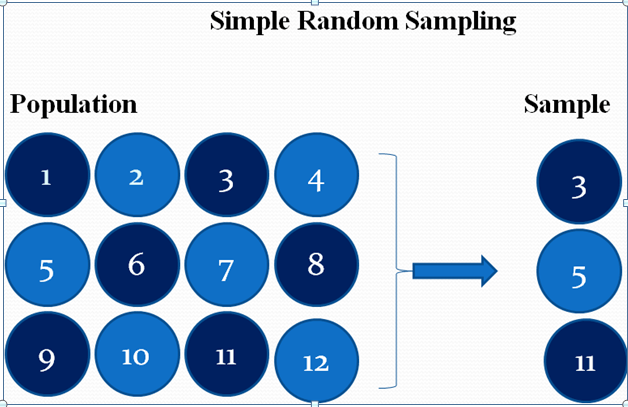
Simple random sampling is the easiest and most popular method of probability sampling. To perform simple random sampling, all a researcher must do is ensure that all members of the population are included in a master list, and that subjects are then selected randomly from this master list. While simple random sampling creates samples that are highly representative of the population, it can be time consuming and tedious when creating large samples.
Simple random sampling selects individuals from a population so each one has an equal and independent chance. Researchers prefer this method because it produces unbiased, representative samples and supports valid generalizations. It is particularly valuable when the population is homogeneous, and the goal is to make fair, reliable inferences without systematic bias.

What is Simple Random Sampling?
Simple random sampling is defined as a technique where every member of the population has an equal probability of selection, independent of the selection of others. This independence and equal chance make it straightforward and fair, reducing sampling bias and enhancing the representativeness of the sample. It requires a complete and accessible list of the population from which random selections can be made, often by random number generators or lottery methods.
Steps of Simple random sampling
We use the following 8-step procedure to draw a simple random sample of n units from a population of N units.
- Assign serial numbers to the units in the population from 1 through N.
- Decide on the random number table to be used.
- Choose an N-digit random number from any point in the random number table.
- If this random number is less than or equal to N, this is your first selected unit.
- Move on to the next random number not exceeding N, vertically, horizontally or in any other direction systematically and choose your second unit.
- If at any stage of your selection, the random number chosen exceeds N, discard it and choose the next random number.
- If, further, any random number is repeated, it must also be discarded and be replaced by a fresh random number appearing next.
- The process stops once you arrive at your desired sample size.
There are two approaches that aim to minimize any biases in the process of simple random sampling:
- Methods of lottery
- Random number table method
Method of lottery
Using the method of the lottery is one of the oldest methods and is a mechanical example of random sampling. In this method, each member of the population has to number systematically and in a consequent manner by writing each number on a separate piece of paper. These pieces of paper are mixed and put into a box and then numbers are drawn out of the box in a random manner.
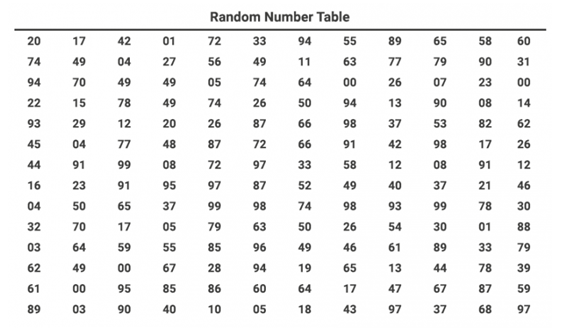
Random number table
The use of random numbers is an alternative method that also involves numbering the population. The use of a number table similar to the one below can help with this sampling technique.

Applications of simple random sampling
- A list of all members of population is prepared. Each element is marked with a specific number (suppose from 1 to N).
- n items are chosen among a population size of N. We can do this either with the use of random number tables or random number generator software.
- The Aromatic Company is planning to conduct a study to estimate the proportion of toilet soap users who prefer a certain color or flavor of their product. In this case, we use a simple random sample of the customers. We assume that a list (sampling frame) of the consumers is available to the research team.
- A forester in Chittagong Hill Tracts may wish to estimate the volume of timber or proportion of diseased trees in a forest by se geographic points in the area covered by the forest and then attaching a plot of fixed size and shape to that point. All the trees within the sample plots may be studied. But again the basic design is a simple random sample.
Advantages of Simple Random Sampling
- It is a fair method of sampling and if applied appropriately, it helps to reduce any bias involved as compared to any other sampling methods involved.
- Since it involves a large sample frame, it is usually easy to pick smaller sample size from the existing larger population.
- The person who is conducting the research doesn’t need to have a prior knowledge of the data collection process. One can simply ask a question to gather the researcher need not be a subject expert.
- This sampling method is a very basic method of collecting the data. It requires no no technical knowledge and basic listening and recording skills.
- Since the population size is large in this type of sampling method there is no restriction on the sample size. From a larger population, you can get a small sample quite easily.
- The data collected through this sampling method is well informed, more the samples better is the quality of the data.
Disadvantages of Simple Random Sampling
- It is a costlier method of sampling as it requires a complete list of all potential respondents to be available beforehand.
- This sampling method is not suitable for studies involving face-to-face interviews as covering large geographical areas have cost and time constraints.
- A sample size that is too large is also problematic since every member of the population has an equal chance of selection. The larger population means a larger sample frame. It is difficult to manage the large population.
- The quality of the data depends on the researcher and his/her perspective. If the researcher is experienced then there are fair chances the quality of data collected is of a superior quality. But if the researcher is inexperienced then the data collected may or may not be up to the mark.
Simple Random Sampling vs Stratified Sampling
Here is a comparison table of Simple Random Sampling vs Stratified Sampling:
| Feature | Simple Random Sampling | Stratified Sampling |
|---|---|---|
| Definition | Every member of the population has an equal chance of selection. | Population is divided into distinct strata, then samples are randomly selected from each stratum. |
| Population Type | Best for homogeneous populations. | Best for heterogeneous populations with distinct subgroups. |
| Sample Composition | Random selection without grouping. | Sampling ensures representation of each stratum. |
| Sampling Frame Requirement | Requires complete list of population. | Requires complete list and information to define strata. |
| Sample Size | Generally larger to achieve same precision as stratified. | Can achieve same precision with smaller sample size. |
| Complexity | Simple and easy to implement. | More complex planning and execution needed. |
| Sampling Error | May have higher sampling error in diverse populations. | Lower sampling error due to control over strata variability. |
| Statistical Analysis | Straightforward analysis. | Requires weighting if disproportionate sampling used. |
| Application Examples | Small studies, populations with no obvious subgroups. | Large surveys, market research, health studies with subgroups. |
| Cost and Time Efficiency | May be less efficient for large, diverse populations. | Often more cost-effective in heterogeneous populations. |
| Control Over Sample Composition | Limited control; purely random. | High control over subgroup proportions. |
Conclusion
Simple random sampling remains a cornerstone of statistical methodology due to its fairness, ease of use, and strong theoretical foundations. By giving every population member an equal chance of selection, it produces unbiased samples that yield valid, trustworthy conclusions about the whole population. Though it has constraints such as the need for complete population lists and potential inefficiency with diverse or large populations, its benefits often outweigh the drawbacks in many research contexts. Proper application of simple random sampling ensures reliable data collection, enhancing the credibility of study findings and informed decision-making. Data Science Blog
Q&A
Q: Why is simple random sampling considered unbiased?
A: Because every population member has an equal and independent chance of selection, preventing systematic favoritism or exclusion.
Q: Can simple random sampling be used with very large populations?
A: Yes, but it can be resource-intensive and require computational tools for random selection from large datasets.
Q: What happens if the population is heterogeneous?
A: Simple random sampling might miss important subgroups; stratified sampling might be more appropriate in such cases.
Q: What tools can be used to conduct simple random sampling?
A: Random number generators, lottery methods, or software designed for statistical sampling.
Q: How does simple random sampling aid in data analysis?
A: It simplifies analysis by ensuring that samples are representative and statistically valid for inference.